What Is a Prepaid Card? The 2026 Guide to Spending Smarter (Without a Bank Account)
—
Key Takeaways
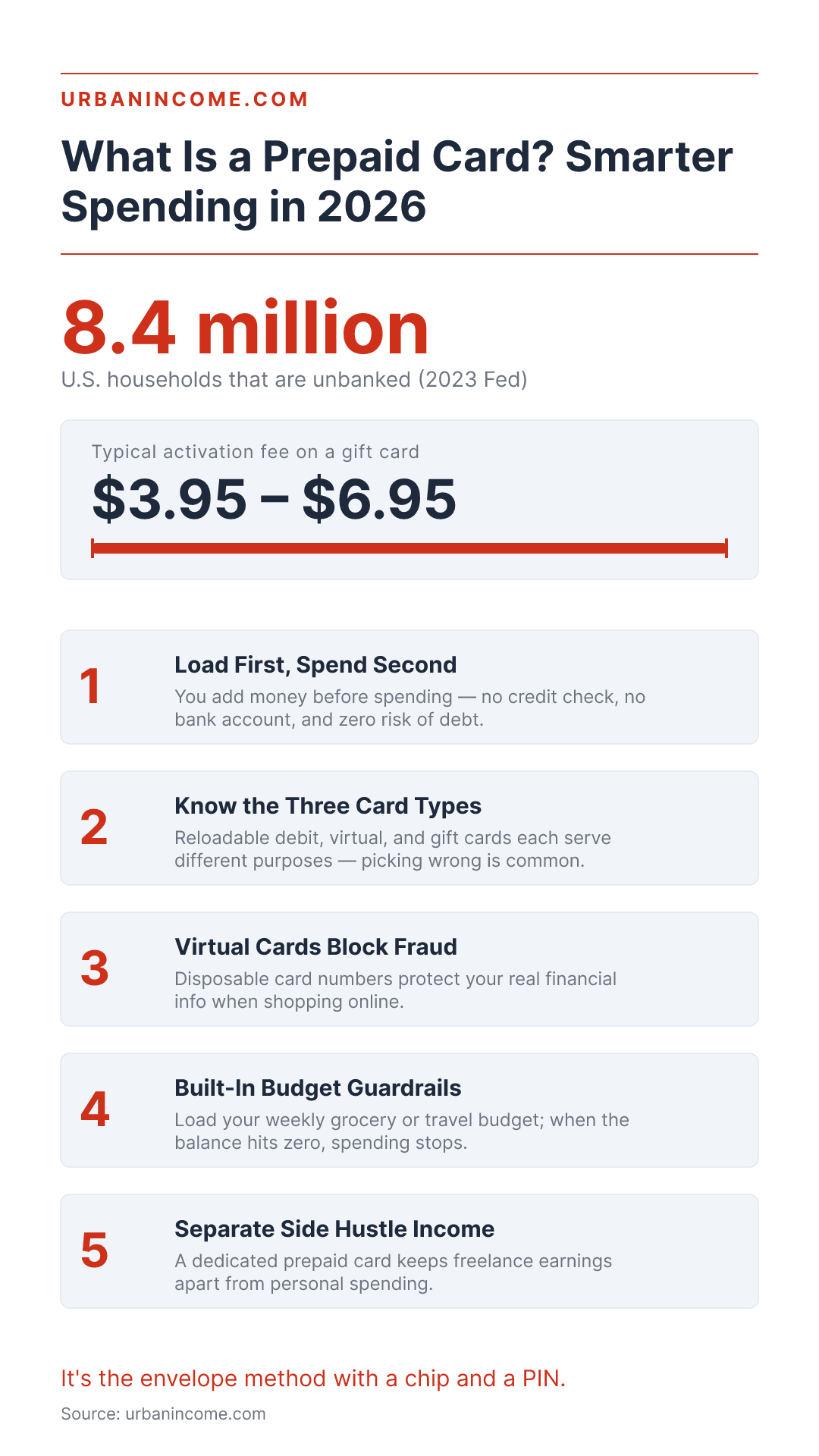
- A prepaid card is a payment card you load with a set amount of money before you spend it, with no credit check, no bank account, and no risk of going into debt.
- Prepaid debit cards, Visa gift cards, and virtual prepaid cards each serve different purposes, and picking the wrong type is the most common beginner mistake.
- Prepaid cards are one of the most effective budgeting tools for side hustlers, teens, and anyone who wants to control spending without a traditional bank account.
- Virtual prepaid cards generate disposable numbers that protect your real financial information from online fraud.
—
According to a 2023 Federal Reserve report on consumer payments, over 8.4 million U.S. households are “unbanked.” Millions more rely on alternative financial tools. And here’s what surprises most people: prepaid cards aren’t just a fallback. They’ve become a go-to spending tool for freelancers, side hustlers, teens, and financially savvy adults who want more control over their money.
But confusion runs deep. People mix up prepaid cards with debit cards, assume they work like credit cards, or dismiss them because of fee horror stories from a decade ago. Most of those assumptions are outdated.
This guide covers what a prepaid card is, how the types differ, and how to use one for spending and income management in 2026. If you’re exploring financial tools on the Urban Income blog, this is a solid starting point.
What Is a Prepaid Card and How Does It Work?
Understanding what is a prepaid card starts with a simple concept: you load money onto it first, then spend only what’s available , no credit check, no bank account, and zero debt risk. Unlike credit cards that lend you money, prepaid cards use funds you’ve already deposited, making them a powerful budgeting tool. At Urban Income, we see prepaid cards as one of the most accessible entry points to financial control for the unbanked, gig workers, and anyone seeking spending discipline.
Types of Prepaid Cards You Should Know
Not all prepaid cards do the same thing. Grabbing the wrong type is one of the most common mistakes beginners make.
Prepaid debit cards are reloadable through direct deposit, bank transfer, or cash at retail locations. Green Dot, Bluebird, and Walmart MoneyCard fall here, functioning as checking account alternatives.
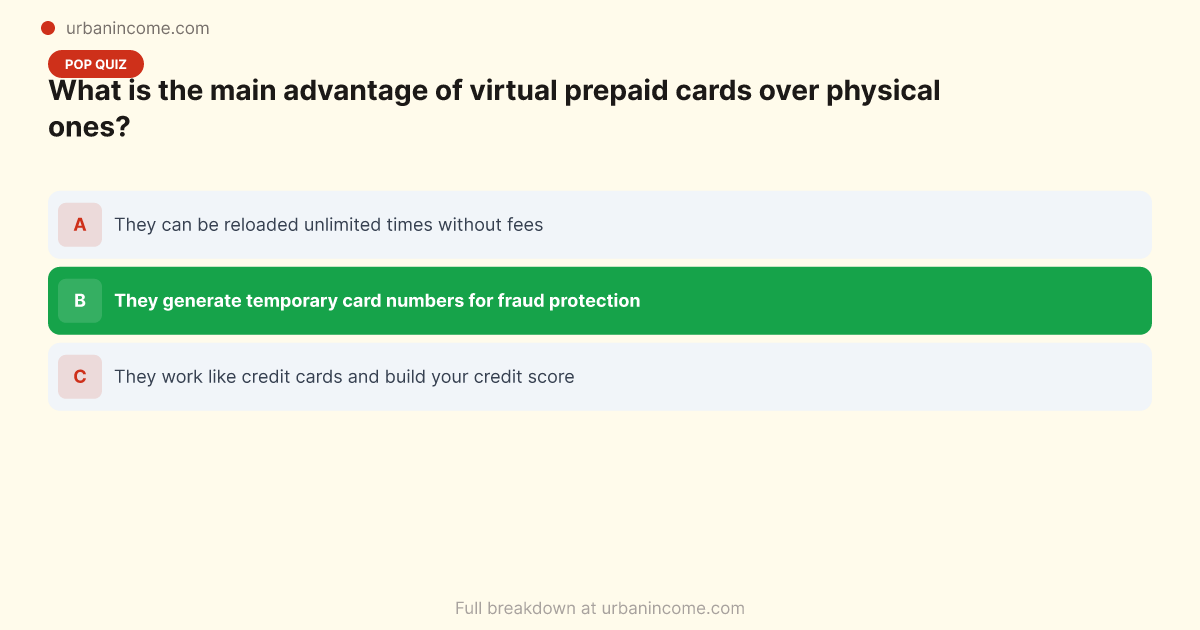
Virtual prepaid cards generate a temporary card number for online purchases, adding a layer of fraud protection that physical cards can’t match. Services like Privacy.com let you create single-use or merchant-locked virtual cards.
Gift cards are non-reloadable. A Visa or Mastercard gift card is a one-time-use prepaid card with a typical activation fee of $3.95 to $6.95. Buy it, spend it down, done.
| Card Type | Reloadable? | Best Use Case | Example |
|---|---|---|---|
| Prepaid debit card | Yes | Daily spending, bill pay | Green Dot, Wisely |
| Virtual prepaid card | Yes (digital) | Online shopping, fraud prevention | Privacy.com |
| Visa/Mastercard gift card | No | Gifts, one-time purchases | Vanilla Visa |
Checking your balance. You can check your prepaid card balance by logging into the card issuer’s website or app, calling the toll-free number on the back of the card, or checking your last transaction receipt. For Visa gift cards, visit the URL printed on the card and enter your card number and CVV.
Using remaining balances. If you have $4.37 left on a $50 gift card, most online retailers won’t split payment across cards. You’ll need a purchase matching the amount or a store allowing split-tender transactions.
Top Uses for Prepaid Cards in Everyday Life
Prepaid cards aren’t a backup plan. They’re a proactive budgeting tool with hard spending limits you literally can’t exceed.
Budgeting. Load a card with your weekly grocery budget. When it’s gone, it’s gone. No overdraft. This envelope-style approach works because the constraint is built into the card itself.
Online shopping safety. Every time you enter your real card number on a website, you’re exposing yourself to fraud. A virtual prepaid card creates a buffer. If the number gets compromised, the damage is limited to whatever small balance you loaded. Your primary accounts stay untouched. For anyone running a side hustle involving digital purchases, that protection is worth its weight in gold.
Travel and subscriptions. Load a card with your exact travel budget. Use one for streaming subscriptions you want to cap. When the balance runs out, the subscription pauses instead of auto-charging your main account.
Prepaid Cards for Teens and Young Adults
Prepaid cards give teens real spending experience with built-in guardrails, making them one of the best starter financial tools available in 2026. According to a 2024 Junior Achievement survey, 89% of teens want to learn more about managing money, but fewer than half feel confident doing it.
Parents load the card, set a limit, and the teen budgets within that boundary. No overdraft fees. No credit risk. Employer-issued cards like Wisely also serve as the first “paycheck card” for teens working part-time. It’s real-world financial education no classroom lecture can replicate.
For parents exploring financial literacy tools, the About page at Urban Income covers the team’s mission around building stronger money habits. Pairing a prepaid card with a simple side hustle creates a closed-loop system: earn, load, spend within budget.
Using Prepaid Cards to Manage Side Hustle Income
Prepaid debit cards are one of the most underrated tools for anyone earning money outside a traditional 9-to-5. A dedicated card lets you separate freelance income from personal spending without opening a second bank account.
Here’s the paradox: the more income streams you build, the harder it gets to track where your money goes. A prepaid card solves that by creating a clean boundary. Load your earnings onto one card, and you instantly see what you’ve earned and spent on business expenses.
Most side hustle apps and freelance platforms support direct deposit to prepaid cards. Earnings from DoorDash, Fiverr, or TaskRabbit can land directly on your card within one to two business days. According to the FDIC’s 2021 survey on unbanked households, roughly 4.5% of U.S. households had no bank account, making employer-issued prepaid cards a critical financial lifeline.
| Strategy | Why It Works | Best For |
|---|---|---|
| One card per income stream | Clean tracking, easy tax prep | Multi-gig freelancers |
| Virtual card for online payments | Fraud protection, instant setup | Remote freelancers |
| Auto-load from direct deposit | Hands-off income management | Delivery drivers |
| Separate card for business expenses | Deductible expenses stay organized | Side hustlers filing Schedule C |
How to Choose the Right Prepaid Card for You
The right prepaid card depends on your goal. A card perfect for budgeting groceries won’t necessarily work for managing freelance income.
Start by getting clear on your purpose: budgeting, gig income management, safer online shopping, or gifting. Each points toward different features. Have questions? Reach out to the Urban Income team for guidance.
| Feature | Why It Matters | What to Look For |
|---|---|---|
| Monthly fees | Eats into balance over time | $0-$5/month; some waive with direct deposit |
| ATM access | Cash withdrawal convenience | Free in-network ATMs |
| Direct deposit | Faster paycheck access | Free with routing number provided |
| Mobile app | Real-time balance tracking | Highly rated with push notifications |
| Network | Where you can use the card | Visa or Mastercard for widest acceptance |
According to NerdWallet’s prepaid card comparison data, the best reloadable prepaid cards with no monthly fees typically require direct deposit to waive charges. Bluebird by American Express consistently ranks among the easiest to get and most affordable to maintain.
—
Frequently Asked Questions
What exactly is a prepaid card and how does it differ from a debit or credit card?
A prepaid card is loaded with funds before you spend. A debit card pulls from a linked bank account, and a credit card lets you borrow money you repay with interest. A prepaid card connects to neither. You can only spend what you’ve loaded, making overspending impossible. No credit check is required, and you don’t need a bank relationship, making prepaid cards especially accessible for unbanked or underbanked users.
Can I use a prepaid card like a Wisely card without a bank account?
Yes. Wisely cards function almost identically to debit cards for everyday purchases and ATM withdrawals. Your funds come from employer direct deposit rather than a checking account. You can shop in stores, pay bills online, and withdraw cash. For millions of workers without traditional bank accounts, cards like Wisely serve as a practical, low-hassle alternative with full electronic payment convenience.
What are the main uses of prepaid cards?
Prepaid cards serve four primary purposes: budgeting, online shopping safety, gifting, and income management. For budgeting, they act as a spending cap you can’t exceed. For online shopping, they provide fraud protection. As gifts, Visa and Mastercard gift cards let recipients choose what they want. For income management, freelancers use reloadable cards to separate business earnings from personal funds. They’re also popular for travel and teen spending accounts.
How do I check my Visa gift card balance?
Visit the website printed on the back of your Visa gift card and enter the card number, expiration date, and security code. Your remaining balance displays immediately. You can also call the toll-free customer service number on the card, where an automated system reads your balance. Checking is always free, and verifying before a purchase prevents declined transactions at checkout.
Can prepaid cards help manage side hustle or freelance income?
Absolutely. Load your side hustle earnings onto a dedicated prepaid card, and every transaction is business-related, making expense tracking and tax preparation dramatically easier. Many gig platforms support direct deposit to prepaid cards. You can use multiple cards for multiple income streams, giving you a clear picture of which hustle is actually making money without needing a business bank account.
Are prepaid cards safe for online shopping?
Yes. Since prepaid cards aren’t connected to your bank account, a compromised card number only exposes the loaded balance. Virtual prepaid cards take this further by generating disposable numbers for single transactions. If that number gets stolen, it’s useless to the thief. This makes prepaid cards particularly smart for shopping on unfamiliar websites or international platforms where fraud risk runs higher.
What is the difference between a Visa gift card and a Mastercard gift card?
The primary difference is the payment network. A Visa gift card works wherever Visa is accepted; a Mastercard gift card works wherever Mastercard is accepted. Both networks have massive global acceptance, so you’ll rarely find a merchant taking one but not the other. Both are non-reloadable. Fees and expiration policies vary by issuer rather than by network. Frankly, either works almost everywhere.
Are prepaid cards good for teens starting their financial journey?
Prepaid cards are excellent for teens learning money management. Parents load a set amount, and the teen budgets within that boundary. No overdraft fees, no credit risk, no access beyond what’s deposited. For teens with part-time jobs, employer-issued cards like Wisely provide immediate access to earnings. Mistakes stay small and teachable rather than financially damaging.
—
Do prepaid cards charge fees?
Yes, many prepaid cards charge fees for monthly maintenance, ATM withdrawals, or reloads, though some providers offer fee-free alternatives. Before selecting a card, compare fee structures across options to understand the total cost of ownership and maximize your savings. Even cards with low or no monthly fees may charge for specific transactions, so review the full fee schedule.
Why is my Revolut card classified as prepaid?
Revolut issues prepaid cards because funds are stored in an e-money account rather than a traditional bank account, which classifies them as prepaid products. While this means some merchants may process transactions slightly differently, Revolut cards work at most payment terminals and online retailers without issue. The prepaid structure doesn’t limit everyday usability for most spending scenarios.
Can I use a prepaid card with side hustle apps?
Yes, most side hustle apps accept prepaid debit cards for both receiving payments and making purchases within the platform. Loading your freelance earnings directly onto a prepaid card helps you keep side income organized and separate from personal spending, making it easier to track earnings and manage your budget. This approach works well for gig workers who want clear financial compartmentalization.
What is a virtual prepaid card?
A virtual prepaid card is a digital-only card with a unique card number, expiration date, and CVV that exists only in digital form. It’s designed exclusively for online transactions and e-commerce purchases, eliminating the need for a physical card while offering added security through temporary or single-use card numbers. Virtual prepaid cards provide convenience and fraud protection for digital spending without the risk of losing a physical card.
Your Next Move With Prepaid Cards
The financial tools available to everyday earners keep getting better, and prepaid cards sit at the center of that shift. Whether you’re managing freelance income, helping a teen learn to budget, or simply want a spending tool that doesn’t require a bank’s permission, a prepaid card puts you in control.
Pick a card that matches your goal. Compare fees, confirm it runs on Visa or Mastercard, and start loading funds. The real question isn’t whether prepaid cards are worth using. It’s whether you can afford to keep managing your money without one.
—
By the Urban Income Editorial Team | Last updated: October 2026
The Urban Income Editorial Team covers personal finance, side hustles, and income-building strategies for budget-conscious earners. Our writers bring backgrounds in financial services, banking, and freelance income management to every guide we publish. Learn more on the Urban Income website.