What Is an Auto Refinance Loan and How It Actually Saves You Real Money in 2026

—
Key Takeaways
- An auto refinance loan is a new car loan that replaces your existing one, typically at a lower interest rate, reducing your monthly payment and total interest paid.
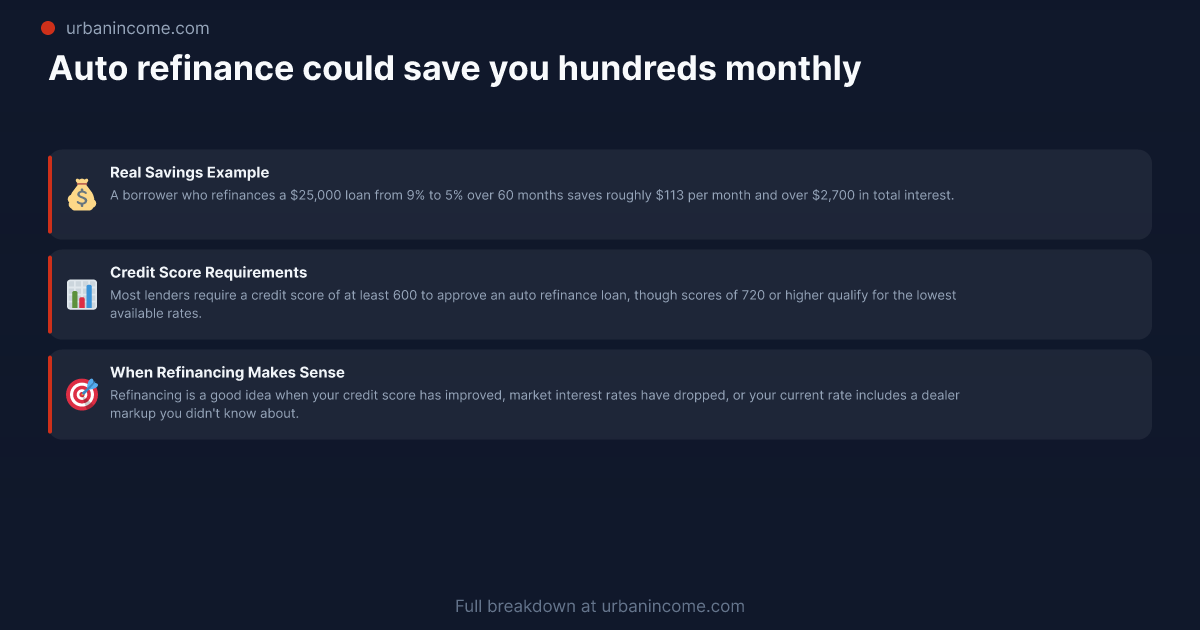
- A borrower who refinances a $25,000 loan from 9% to 5% over 60 months saves roughly $113 per month and over $2,700 in total interest.
- Most lenders require a credit score of at least 600 to approve an auto refinance loan, though scores of 720 or higher qualify for the lowest available rates.
- Dealer rate markups silently inflate your original loan’s interest rate, and refinancing is often the only way to undo that hidden cost.
- If your remaining balance is under $5,000 or you’re within six months of payoff, refinancing fees can outweigh the savings.
—
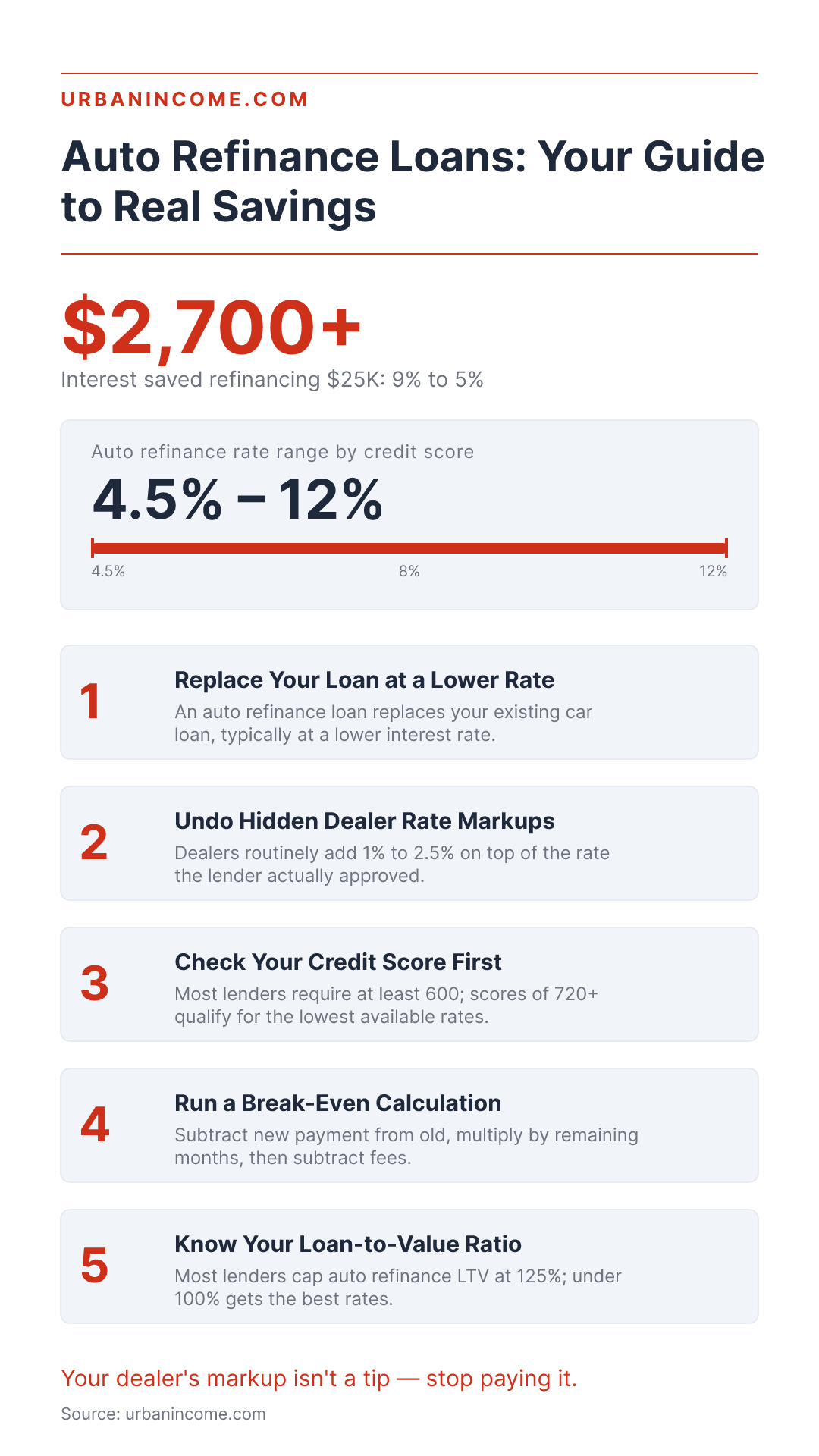
Here’s what most people don’t realize in 2026: the auto loan you signed at the dealership almost certainly includes a rate markup you never agreed to. Dealers routinely add 1% to 2.5% on top of the rate the lender actually approved, and that markup is pure profit for the dealer. It’s not illegal. It’s not disclosed in bold print. And it costs the average borrower hundreds a year.
Refinancing is how you fix that. This guide from Urban Income’s blog breaks down what an auto refinance loan is, shows real savings with before-and-after scenarios, and gives you the credit score and vehicle requirements you’ll need to qualify.
What Is Auto Refinance Loan and How Does It Work?
What is auto refinance loan, exactly? It’s a new car loan that replaces your existing one , typically at a lower interest rate , reducing your monthly payment and total interest paid. At Urban Income, we break down how this swap works so you can decide whether refinancing is your smartest financial move.
Real Dollar-Amount Savings: Before and After Scenarios
Refinancing is a good idea when your credit score has improved since you took out the original loan, when market interest rates have dropped, or when your current rate includes a dealer markup you didn’t know about. But “good idea” is vague. Let’s put real numbers on it.
Here’s the paradox: the people who need the savings most often assume they won’t qualify, while borrowers with great credit skip refinancing because they figure the savings are too small. Both groups are wrong.
| Scenario | Original Loan | Refinanced Loan | Monthly Savings | Total Interest Saved |
|---|---|---|---|---|
| A: Dealer markup fix | $25,000 at 9.0% / 60 mo ($519/mo) | $22,000 at 5.0% / 48 mo ($507/mo) | $12/mo (but 12 fewer months) | ~$2,780 |
| B: Credit score jump | $18,000 at 12.0% / 60 mo ($400/mo) | $15,500 at 7.0% / 48 mo ($371/mo) | $29/mo | ~$1,890 |
| C: Rate drop + term keep | $30,000 at 8.5% / 72 mo ($534/mo) | $26,000 at 5.5% / 54 mo ($490/mo) | $44/mo | ~$3,150 |
Scenario A is the one competitors never mention. That 9% rate likely included a 2% dealer markup on top of the 7% the lender actually approved. According to Experian’s auto finance data, the average used car loan rate in early 2026 sits around 11.5% for subprime borrowers, meaning savings potential for anyone whose score improved since purchase can be substantial.
Break-Even Analysis: When Refinancing Costs More Than It Saves
To calculate whether an auto refinance saves you money, subtract your new monthly payment from your current one, multiply that difference by the remaining months on your loan, then subtract any refinancing fees to find your net savings.
Net Savings = (Old Payment – New Payment) × Remaining Months – Fees
Fees typically run $50 to $250. If your monthly savings are $40 and fees total $150, you break even in about four months. That’s worth its weight in gold compared to leaving money on the table.
But if your remaining balance is under $5,000 or you’re within six months of payoff, the math flips. I’d argue that refinancing a loan you’re about to pay off is like buying a gym membership in November and canceling in January.
Credit Score, LTV, and Vehicle Requirements for Approval
In 2026, borrowers with credit scores of 720 or higher can typically secure auto refinance rates between 4.5% and 6.0%, while those in the 600 to 680 range often see rates from 8% to 12%, depending on the lender and loan-to-value ratio.
Most lenders set a floor around 600. But the tier matters: the gap between a 650 and a 720 can mean 3 to 5 percentage points, translating to thousands over the loan’s life.
The loan-to-value ratio (LTV) compares what you owe to what the car is worth. Most lenders cap auto refinance LTV at 125%. Above that, you’re in negative equity territory, which makes approval harder and rates higher.
| Factor | Minimum for Approval | Sweet Spot for Best Rates |
|---|---|---|
| Credit Score | 600+ | 720+ |
| Loan-to-Value Ratio | Under 125% | Under 100% |
| Vehicle Age | Under 10 years | Under 7 years |
| Vehicle Mileage | Under 150,000 miles | Under 100,000 miles |
| Remaining Loan Balance | $5,000+ | $7,500+ |
The uncomfortable truth is that negative equity often means you’re better off making extra payments to get right-side-up before attempting to refinance. If your score is below 600, spend 3 to 6 months improving it: pay down credit card balances to get utilization under 30%, dispute errors through myFICO, and avoid opening new accounts. A 50-point jump can shift your rate by 2 or more percentage points.
When to Refinance vs. When NOT to Refinance
The best time to refinance is when rates have dropped since you originally financed, your credit score has climbed meaningfully, or you’re still in the first half of your loan term with a substantial balance remaining.
And here’s the paradox most borrowers miss: the moment you feel most comfortable with your payments is often the worst time to refinance, because you’ve already paid through the expensive, interest-heavy portion of the loan.
Avoid refinancing if your car’s value has dropped below your balance and you can’t close that gap. Divide total fees by monthly savings to find how many months until you’re ahead. If that number is 8 and you only have 12 months left, the savings are too thin. If it’s 4 months and you have 36 remaining, you’re looking at a solid win.
Refinancing after just a few months can save serious money if your credit jumped 40 to 50 points or market rates dropped noticeably. You haven’t paid much principal yet, so the bulk of interest charges are still ahead. Watch for prepayment penalties on your original loan. According to myFICO’s auto loan guidance, most major lenders have moved away from them, but dealer-arranged financing and some subprime lenders still include them.
Not sure whether your situation calls for refinancing? Reach out to the Urban Income team for guidance matched to your specific numbers.
Put Your Savings to Work: Extra Income Ideas From Urban Income
Refinancing isn’t just about paying less each month. It’s about what you do with the freed-up cash. Even $80 in monthly savings adds up to over $1,000 a year.
So redirect those savings into beginner investing. Micro-investing apps let you start with as little as $5, and index funds offer diversified exposure without picking individual stocks. The Urban Income blog covers beginner investing strategies and extra income ideas designed for readers at exactly this stage.
Honestly, combining refinance savings with even a modest side hustle creates a financial flywheel. You’re not just saving money. You’re generating it. To miss the boat on that opportunity would be leaving real wealth-building potential untouched. Side hustle apps like TaskRabbit, Instacart, and Steady make finding gigs straightforward, and even an extra $200 per month applied to your auto loan principal can shave months off your payoff timeline.
—
Frequently Asked Questions
How do auto refinance loans work and what should I know before applying?
An auto refinance loan replaces your existing car loan with a new one at better terms. You shop rates from multiple lenders, and once approved, the new lender pays off your old loan directly. You’ll typically need proof of income, your current loan account number, vehicle registration, and a valid ID. The process usually takes one to two weeks. Compare at least three offers before committing.
What credit score do I need for a better auto refinance rate?
Most lenders require a minimum around 600, but 720 or higher opens the door to the best rates. The difference between a 620 and a 750 can mean 3 to 5 percentage points. Before applying, check your score through a free service and dispute any errors. According to Equifax’s credit education resources, correcting report inaccuracies is one of the fastest ways to improve your score.
Is it worth refinancing if I’ve only had my loan a few months?
Yes, if rates dropped or your credit improved since signing. Because you haven’t paid much principal yet, most remaining payments are interest-heavy, so a lower rate saves the most during this early window. Check for prepayment penalties. Even a 1.5% rate reduction on a $20,000 balance typically justifies refinancing within the first six months.
Does refinancing hurt my credit score or reset my loan timeline?
Refinancing causes a small, temporary dip of 5 to 10 points from the hard inquiry, which recovers within months. If you apply to multiple lenders within a 14-day window, most scoring models count those inquiries as a single event. Refinancing resets your loan term to whatever new term you choose, but your payment history on the original loan stays on your credit report.
When should I refinance versus just pay off the loan?
Refinance when rates have dropped or your credit improved and you have a substantial balance remaining. Divide total fees by monthly savings to find your break-even point. If that point falls well before your loan’s end date, refinancing wins. If you’re within the last 12 months and remaining interest is minimal, paying it off is usually smarter.
Can you refinance with bad credit and still get a lower rate?
Yes, especially if your score improved even slightly since the original loan. Many borrowers initially finance through dealerships at inflated rates, so even modest credit improvement can qualify you for a better deal through a credit union or online lender. You might not get rock-bottom rates, but dropping from 14% to 9% still saves real dollars every month.
What is loan-to-value ratio and why does it matter?
LTV compares your current loan balance to your car’s market value. Most lenders cap auto refinance LTV at 100% to 125%. Negative equity can block approval or result in unfavorable terms. Check your car’s value through Kelley Blue Book or NADA Guides. If your LTV is too high, consider making extra payments before applying.
Does vehicle age or mileage disqualify me from refinancing?
Many lenders set limits around 10 model years and 100,000 to 150,000 miles. Some credit unions and specialty online lenders are more flexible, particularly if your credit profile is strong. Don’t assume you’re disqualified without checking. Call local credit unions directly, as they often have more lenient vehicle age policies than national banks.
Are there fees or hidden costs when refinancing?
Common costs include title transfer fees, lender origination fees, and state re-registration charges, typically $50 to $500. Some lenders advertise “no-fee” refinancing but build costs into a higher rate. Divide total fees by monthly savings to determine how many months until you’re genuinely ahead. Ask every lender for a full fee breakdown before signing.
—
What are some side hustles from home to use my refinance savings?
Popular options include freelance work online, side hustle apps, and low-cost business ideas that fit around your schedule. Urban Income’s blog features curated lists of extra income ideas tailored to different skill levels and time commitments, helping you put your refinance savings to work even faster.
How can beginner investing help grow my auto refinance savings?
Investing even small monthly savings into index funds or micro-investing apps compounds wealth over time, turning your refinance gains into long-term financial growth. Urban Income’s beginner investing resources walk you through low-barrier entry points and strategies designed for people just starting their investment journey.
What is cash-out auto refinance and when should I use it?
A cash-out auto refinance lets you borrow more than your current loan balance and pocket the difference as cash, useful for consolidating debt or covering emergencies. However, it increases your total debt and extends repayment, so it works best when you have significant equity in your vehicle and a clear plan for the borrowed funds.
Your Next Move Starts With the Math
Auto refinancing isn’t complicated, but it requires you to crunch the numbers honestly. Check your current rate, pull your credit score, look up your car’s value, and calculate the break-even timeline. If the math works, you’re leaving money on the table every month you wait.
Once you’ve locked in savings, don’t let them sit idle. Whether you channel that freed-up cash into beginner investing, a side hustle from home, or accelerated loan payoff, make every dollar work harder than it did yesterday.
The readers who get the most out of refinancing aren’t the ones with perfect credit. They’re the ones who actually take the 30 minutes to apply.
—
The Urban Income Editorial Team covers personal finance, side hustles, and beginner investing strategies for readers building wealth from the ground up. Learn more at urbanincome.com/about.